Liu Yao Coin Divination for Beginners: Toss Three Coins, Ask About Money
BaZi reads your whole life; Zi Wei reads your chart's architecture. But when your question is one specific decision — "should I take this deal?", "is now a good time to buy?" — the classical tool built for the job is Liu Yao (六爻, "six lines") divination. Three coins, six tosses, one hexagram. This guide covers the basics from zero: how a hexagram is cast, what all the labels on it mean, and why money questions always come down to one line — the Wife-Wealth line.
What Is Liu Yao? How Is It Different from BaZi?
> 📌 Key takeaway: Liu Yao is event divination; BaZi is fate analysis. BaZi uses your birth time to map your life's overall pattern and yearly cycles. Liu Yao needs no birth data at all — one question, one hexagram. You hold a specific question in mind, toss the coins, and the hexagram answers only that question. The two aren't substitutes: BaZi tells you this year's financial climate, Liu Yao helps you judge the single step in front of you.
Liu Yao grows out of the 64 hexagrams of the I Ching. In the Han dynasty, the scholar Jing Fang created the Najia (納甲) system, mapping the heavenly stems, earthly branches, five elements, and six relations onto the hexagram's lines — and that is the method still practiced today. Unlike temple lot-drawing, where each lot has a fixed verse, a Liu Yao hexagram's entire structure is assembled on the spot from your actual tosses, then analyzed line by line through five-element interactions. It's a rule-based reasoning system, not a lucky dip.
If the "fate analysis" side interests you more, start with What Is BaZi? and BaZi vs Zi Wei Dou Shu.
How Do Three Coins Build a Hexagram?
> 📌 Key takeaway: Traditionally you shake three coins (Qianlong-era bronze coins are the classic choice) and toss them, reading the mix of "inscribed" and "blank" faces: one blank + two inscribed = young yang (solid line); two blanks + one inscribed = young yin (broken line); three blanks = old yang (moving solid line); three inscribed = old yin (moving broken line). Six tosses stack from the bottom up into a hexagram. Any moving lines transform the hexagram into a second one — the "changed hexagram" — which shows how the situation develops.
A few traditional rules of casting:
- Hold the question in your mind: one hexagram per question, and the more specific the better. Not "how's my money this year?" but "if I invest this amount now, how do the next three months go?"
- Record the casting time: a reading depends on the month branch and day pillar (the date's stem-branch) — the same hexagram has completely different strength on different days, which is why any serious Liu Yao tool records when the cast happened.
- Cast once, sincerely: tradition forbids re-casting the same question because you didn't like the answer — that's treating the first hexagram as if it never happened.
What Do All the Labels Mean? Najia, Six Relations, Self and Other
Once cast, each line carries labels like "Wife-Wealth, Zi Water" or "Officer-Ghost, Yin Wood." These come from Najia attribution:
| Term | Meaning | Role in reading |
|---|---|---|
| Najia | Mapping stems and branches onto the six lines | Gives each line an element so interactions can be computed |
| Six relations | Parents, Siblings, Offspring, Wife-Wealth, Officer-Ghost | Different questions take different relations as the "focal deity" |
| Self / Other lines | The Self line is you; the Other line is the counterparty or environment | Shows your position relative to the matter |
| Moving lines | Lines cast as old yin or old yang | Where the situation is changing |
| Void | Branches "empty" for that day's ten-day cycle | A line in void loses most of its force |
Don't memorize it all at once. The one skill a beginner needs is finding the focal deity (用神): which of the six relations represents the thing you asked about.
Asking About Money: Why the Wife-Wealth Line?
> 📌 Key takeaway: Each of the six relations has its jurisdiction — career and promotion read the Officer-Ghost line, children and health the Offspring line, contracts and paperwork the Parents line, and all questions of money, investment, and business take "Wife-Wealth" (妻財) as the focal deity. The core of the reading is whether that line has strength this month and this day: supported by the month and day pillars, wealth is attainable; countered, in void, or with the Siblings line (the "wealth robber") in motion, the omen is "wealth won't gather."
A real example: asking about BTC, the cast returns Mountain-Fire Bi changing to Mountain-Heaven Da Chu. The Wife-Wealth line (Hai Water) is weak in the month, countered by the day, and the Siblings line is moving — robbing wealth. The verdict reads: "The focal deity has no strength; wealth won't gather. This hexagram's greatest taboo is outsmarting yourself buying the dip — below the bottom there is often another bottom." You don't need to parse every character to see the point: a Liu Yao money reading isn't intuition, it's a step-by-step audit of one line's strength.
For the fate-analysis view of your underlying wealth pattern, pair this with Reading Wealth, Love, and Career in BaZi and the Yearly Fortune Guide.
Want to Try It Now? Liu Yao BTC — Toss Three Coins, Ask One Question
The fastest way to learn is to cast a hexagram yourself. Our team built a free tool, Liu Yao BTC:
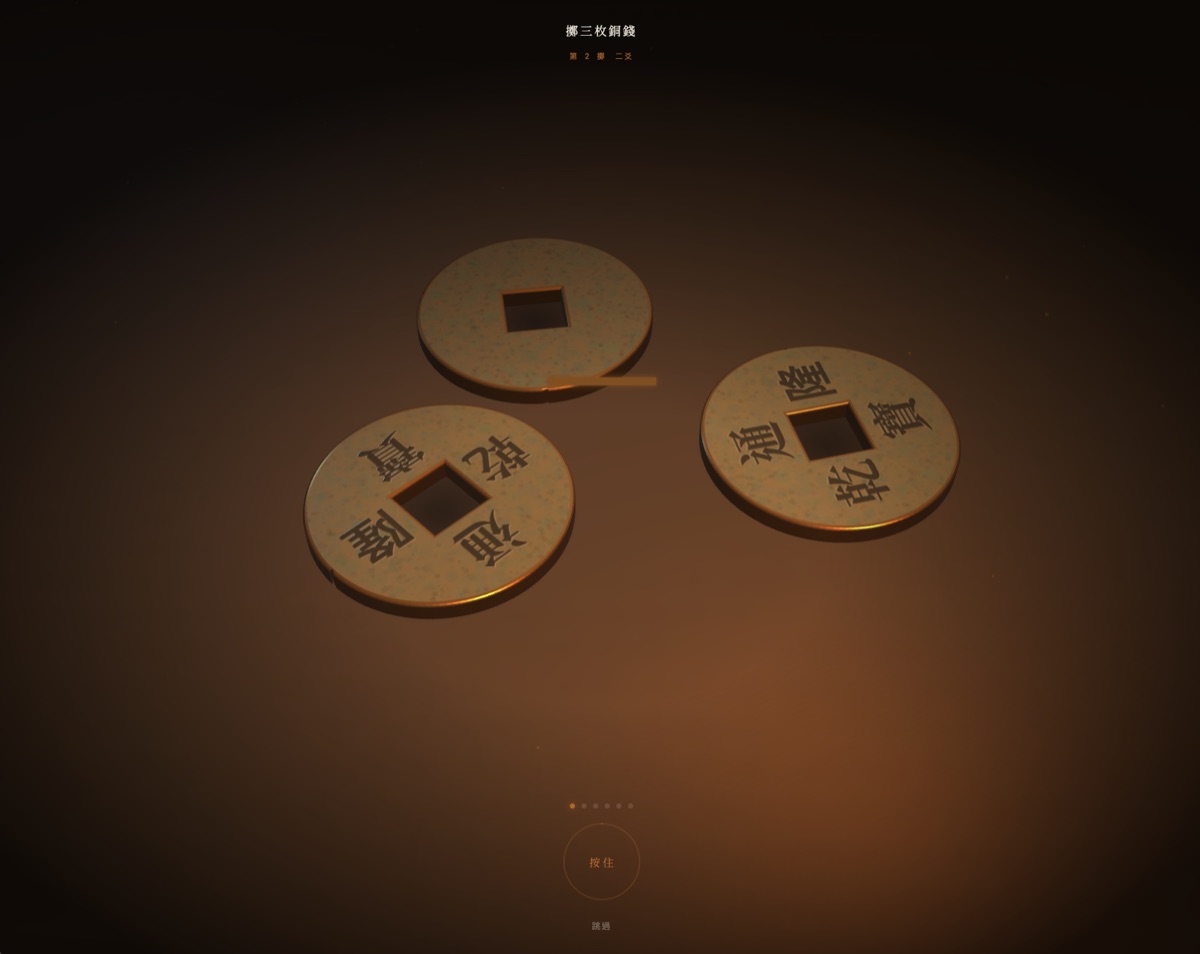
- The full casting ritual: three 3D bronze coins, press-and-hold to toss, six real tosses — not a random hexagram handed to you
- Authentic Najia attribution: six relations, Self/Other, moving lines, and voids assigned automatically, with the casting hour, month branch, and day pillar all computed in
- Wealth as the focal deity: verdicts are written from the Wife-Wealth line's strength, displayed against the live BTC price
- Five languages supported, with one-tap sharing of your hexagram
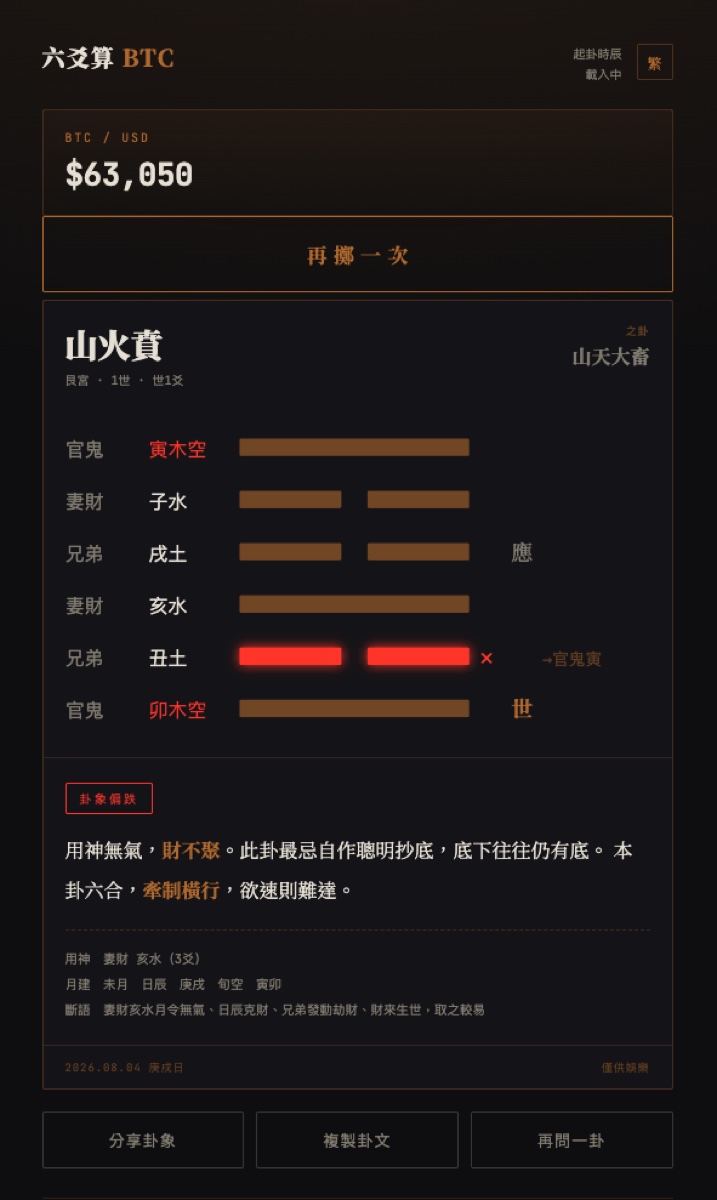
Cast one yourself at www.liuyao-btc.com.
The obligatory disclaimer, sincerely meant: hexagrams do not predict markets — entertainment only, not investment advice. What makes Liu Yao worthwhile is that it forces you to turn a vague anxiety into one specific question. That step alone beats how most people make decisions.
FAQ
"Is Liu Yao accurate?" Like all divination arts, it's an interpretive framework, not a crystal ball. Its value is a structured lens for thinking a matter through — not a substitute for your own judgment. Where real money is involved, your research and risk management always come first. "Can I re-ask the same question?" Traditionally, no — "the first divination speaks; the second and third profane it, and it speaks no more." One matter, one hexagram. "Do the coins need a master's blessing?" No. Liu Yao has always been a scholar's self-casting art — three coins and a pen are enough. What matters is the method and sincerity, not ceremony.Further Reading
- What Is BaZi? The Four Pillars Explained
- Reading Wealth, Love, and Career in BaZi
- Yearly Fortune: BaZi Annual Cycles vs Zodiac Forecasts
- BaZi vs Zi Wei Dou Shu: What's the Difference?
Want your own 2027 BaZi forecast?
Enter your birth date and time — AI charts your four pillars and reads your Ten Gods, elements and yearly luck. Basic chart is free
Chart My BaZi Free